A claim I have heard many times online and from other people is that humans only use 10% of their brains. According to this claim, the other 90% is unused potential that people could somehow learn to access. At first, this sounds believable because the human brain is extremely complicated and scientists are still studying how it works. Movies, social media posts, and motivational content have also repeated the idea for years.
However, I became skeptical because the claim gives a very specific percentage without explaining where that number came from. If humans actually used only 10% of their brains, I would expect there to be strong scientific evidence supporting that number. I decided to use the SIFT method to investigate the claim instead of accepting the first answer I found.
Step 1: Stop and Examine the Claim
The first step of SIFT is to stop before immediately believing or sharing information.
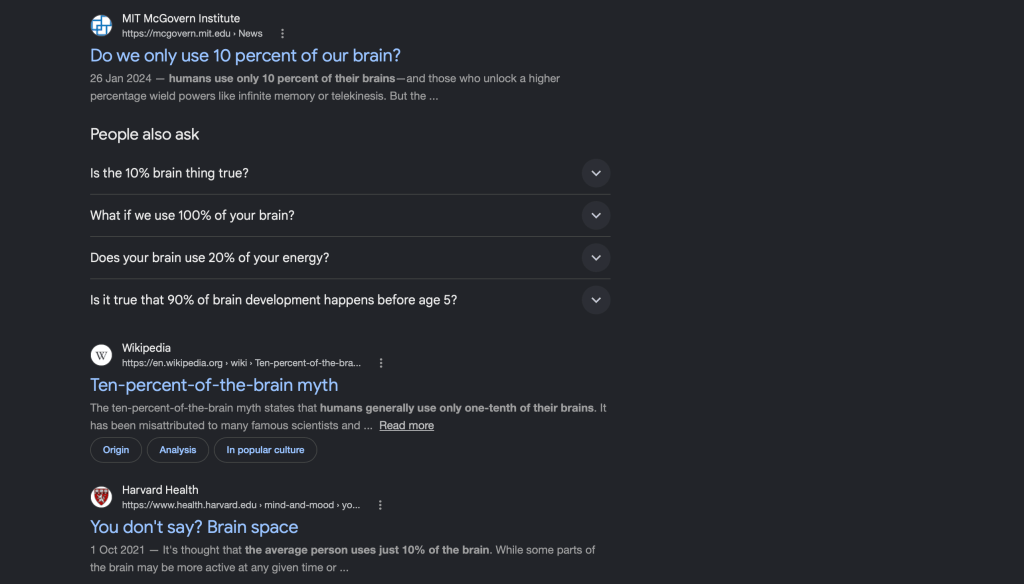
I searched Google for the phrase “humans only use 10 percent of their brain.” Before clicking anything, I looked at the types of sources appearing in the results. Several results immediately described the statement as a myth.
This was important because a search result alone does not prove that something is true or false. However, seeing several scientific and educational sources questioning the claim gave me a reason to investigate further.
Step 2: Investigate the Source
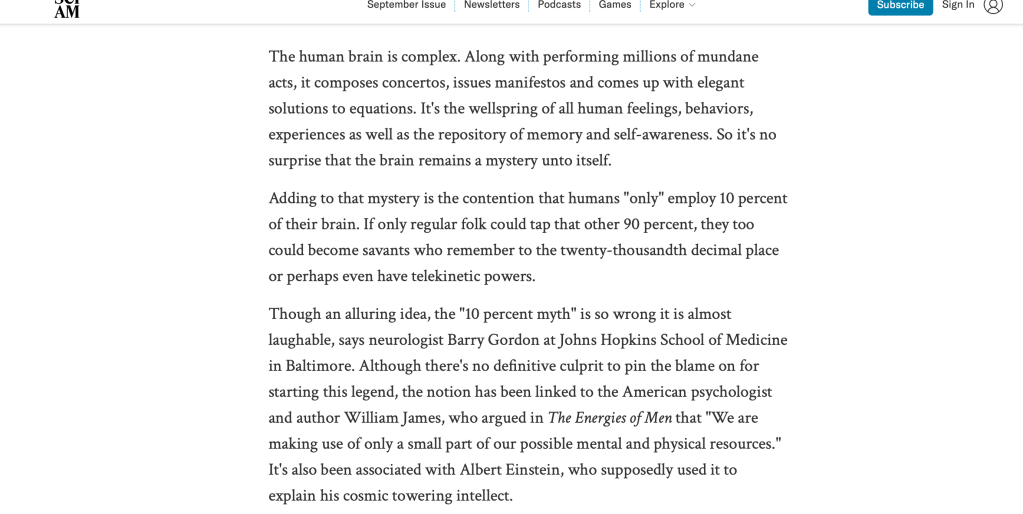
Next, I opened an article from Scientific American titled “Do People Only Use 10 Percent of Their Brains?”
I wanted to know whether the article was simply repeating someone else’s opinion or whether it included information from experts. Scientific American discussed explanations from neurologists, including Barry Gordon of Johns Hopkins School of Medicine.
The article explains that humans use virtually every part of the brain. Different areas become more or less active depending on what a person is doing, but that does not mean 90% of the brain is permanently unused. Brain imaging has shown that many different areas remain active throughout normal activities and even during sleep.
This made the Scientific American article much stronger evidence than a random social media post because it identified experts and explained the scientific evidence behind its conclusion.
Step 3: Find Better Coverage
Instead of relying on one article, I searched for other sources discussing the same claim.
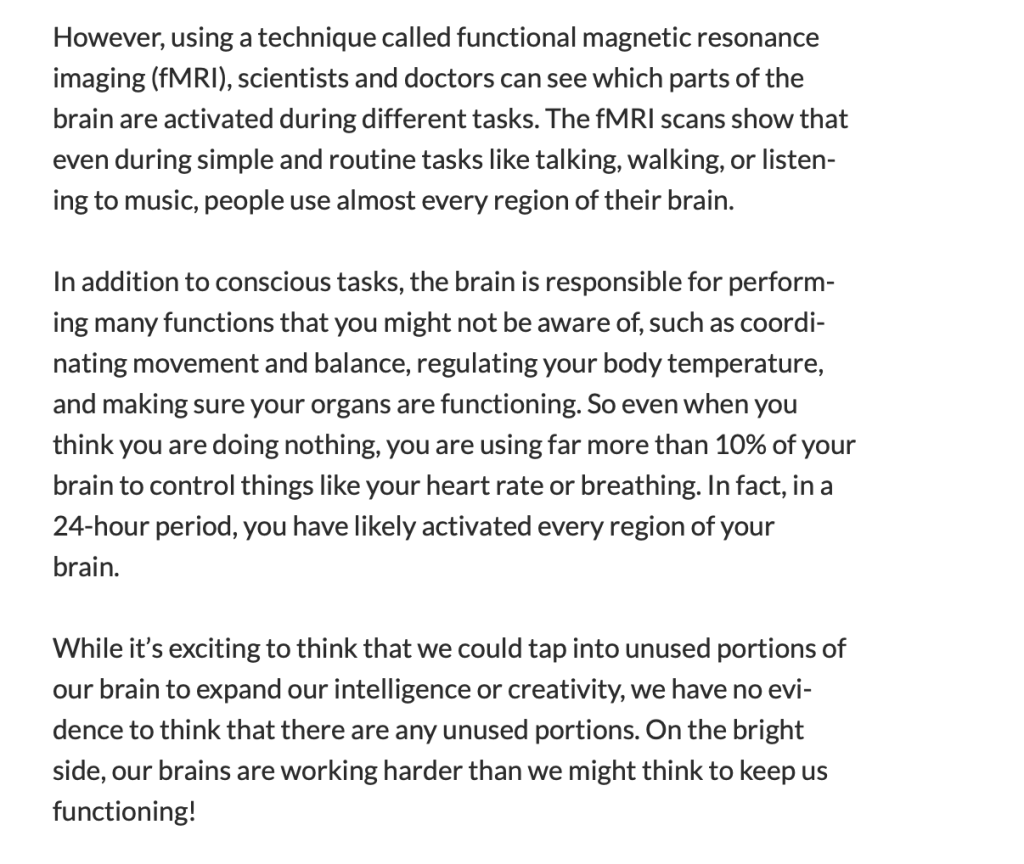
I found an article from the University of Texas at Austin titled “Do we only use 10% of our brain?” The article also identifies the statement as a misconception. It explains that functional magnetic resonance imaging, or fMRI, allows researchers to see which areas of the brain become active while people perform different activities.
According to the article, activities such as walking, talking, and listening to music involve many parts of the brain. Even when someone appears to be doing nothing, the brain still performs functions such as controlling breathing, heart rate, body temperature, and other processes.
Finding similar explanations from separate sources increased my confidence that the 10% claim was inaccurate.
Step 4: Check Another Medical Source
I also wanted a source that focused specifically on medical information.
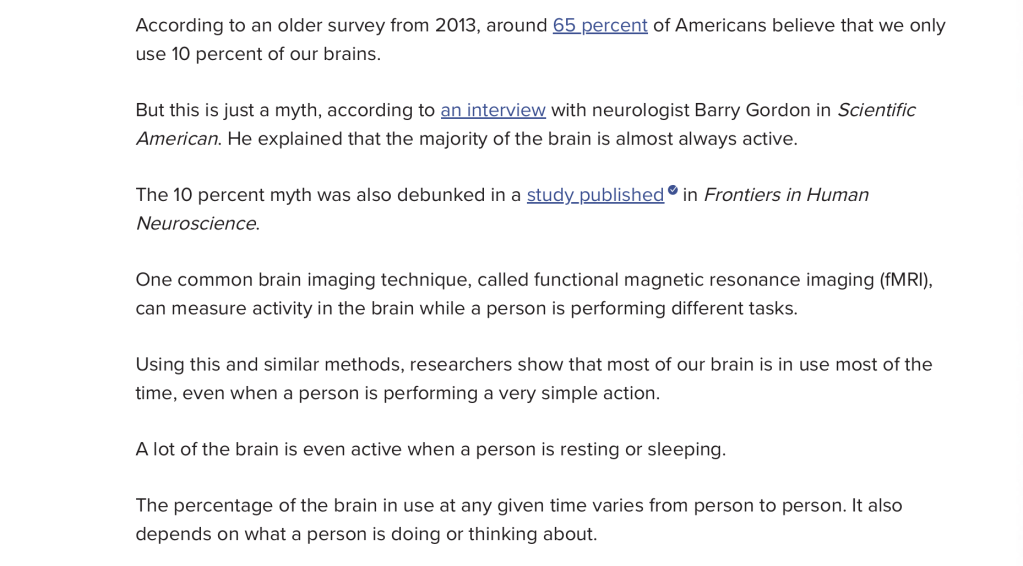
Medical News Today has an article titled “What percentage of our brain do we use?” The article was medically reviewed and explains that research does not support the idea that people only use 10% of their brains.
The article discusses fMRI technology and explains that most of the brain is in use throughout normal life. It also makes an important distinction. Humans do not necessarily use every part of the brain at maximum activity at the exact same moment. Instead, different areas perform different functions and become active when they are needed.
That distinction may explain why the 10% claim sounds believable. Saying that every neuron is not active at exactly the same moment is very different from saying that 90% of the brain is completely unused.
Step 5: Trace the Claim Back to Its Origins
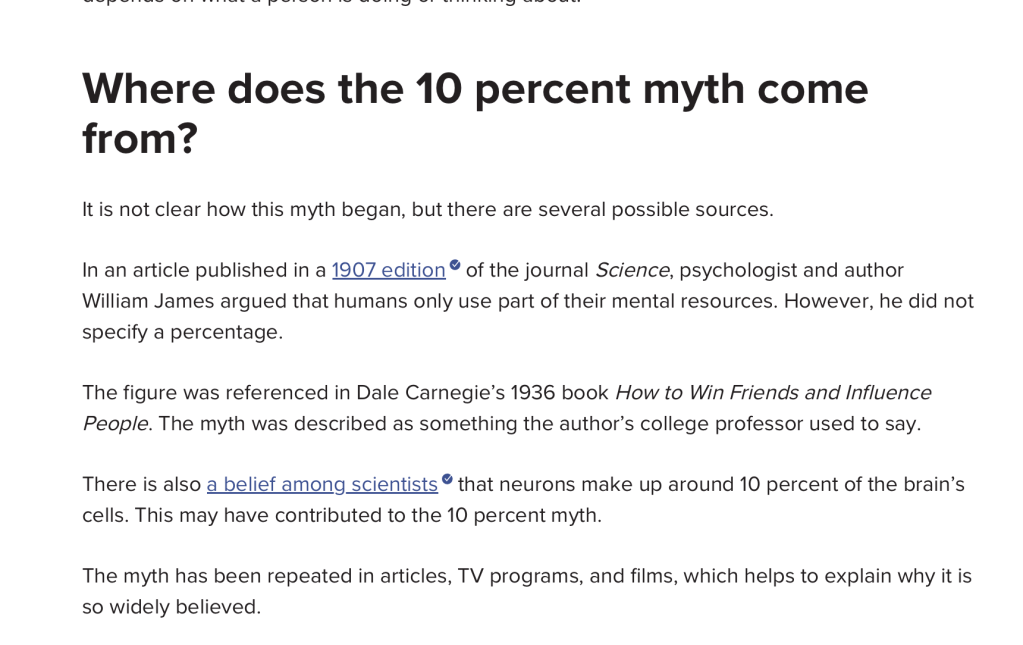
The final part of my investigation was trying to understand where the claim came from.
The University of Texas article explains that the myth may have developed from ideas expressed by psychologist William James during the early 1900s. James suggested that people only use a small portion of their possible mental and physical resources. However, that statement was about people failing to reach their full potential. It was not scientific evidence that 90% of the physical brain remains unused.
Scientific American also discusses the connection to William James and notes that the claim has sometimes been associated with Albert Einstein. There is no solid scientific basis for turning these ideas into a statement that humans literally use only 10% of their brains.
Tracing the claim helped me see how information can change as it is repeated. A general statement about human potential can eventually turn into a scientific-sounding claim with a specific percentage attached to it.
Final Assessment
After using the SIFT process, I concluded that the claim that humans only use 10% of their brains is false. Multiple independent sources explain that brain imaging and neurological research show activity throughout the brain. Different areas perform different jobs, so every region does not operate at maximum activity at the same time. That does not mean the remaining areas are unused.
This investigation also showed me why verifying information matters. A claim can become familiar simply because people repeat it for years. Familiarity does not make something accurate. Claims that include scientific language, statistics, or famous names can sound convincing even when the evidence behind them is weak. Instead of immediately accepting or sharing information, people should stop, investigate the source, look for independent coverage, and trace important claims back to their original context. These steps take more time than simply reading a headline or social media post, but they can prevent misinformation from continuing to spread.
Sources:
Robynn Boyd, Do People only Use 10% of Their Brains, https://www.scientificamerican.com/article/do-people-only-use-10-percent-of-their-brains/
Emily Samson, DO WE ONLY USE 10% OF OUR BRAIN?, https://sites.utexas.edu/think-twice/2021/09/14/do-we-only-use-10-of-our-brain/
MEDICAL NEWS TODAY, https://www.medicalnewstoday.com/articles/321060
MEDICAL NEWS TODAY, https://www.medicalnewstoday.com/articles/321060
 Jordan Robinson
Leave a comment